Term 01Category: Theological belief
Male-Headship / Patriarchal Theology
Male-headship theology generally teaches that God has assigned husbands a particular leadership or “headship” role within marriage.
Christians disagree about exactly what biblical headship means. Not everyone who holds complementarian or male-headship beliefs believes husbands possess unlimited authority, sexual authority, or that wives should tolerate abuse.
The danger: when headship becomes entitlement or compulsory obedience
- “He is your husband. You need to obey him.”
- “A submissive wife doesn’t tell her husband no.”
Marriage does not turn spiritual leadership into sexual authority over another person’s body.
A theological belief about marital roles does not erase a spouse’s agency, safety, boundaries, or consent.
Term 02Category: Teaching
Marital Duty / Marital Debt Theology
This teaching can frame sexual access as something one spouse owes another because they are married. 1 Corinthians 7:3–5 is sometimes used in these discussions.
Scripture · read the whole verse
“The wife does not have authority over her own body, but the husband does. Likewise the husband does not have authority over his own body, but the wife does.”
Notice the second half
“Likewise the husband does not have authority over his own body, but the wife does.”
Paul’s statement is mutual. He did not establish:
Not established: Husband = OwnerNot established: Wife = Property
Marriage is a covenant, not ownership.
Interpretation: Whatever one’s theology of marital intimacy, Scripture should not be reduced to a weapon for demanding sexual compliance.
Term 03Category: Teaching
Sexual Submission Theology
The idea that being a submissive Christian wife requires meeting her husband’s sexual desires even when she does not want sexual activity. In this teaching, a wife may be told she is obligated to meet her husband’s sexual desires even when she does not want sexual activity.
A belief some women carry
- “If I say no to my husband, I’m saying no to God.”
For someone whose relationship with God is central to her identity, this belief can become extraordinarily powerful. Refusing unwanted sex stops feeling like a personal boundary and starts feeling like disobedience to God—so fear of spiritual failure can silence her own “no” before she ever says it.
Sex obtained through fear, intimidation, persistent pressure, threats, shame, manipulation, retaliation, or spiritual condemnation is not healthy mutual intimacy.
Term 04Category: Theological framework
Biblical Patriarchy
Biblical patriarchy is a broader theological framework that may place men in authority within the family, church, or both.
Not everyone who believes husbands and wives have different roles believes women should tolerate abuse.
The danger: a progression like this
- Men lead.
- Women obey.
- Women stay quiet.
- Men make the final decisions.
- A wife’s resistance is rebellion.
- Questioning male authority is questioning God.
Environments that discourage questioning, disclosure, boundaries, outside help, or accountability can make abuse more difficult to identify and report.
Term 05Category: Cultural teaching
Purity Culture
Some purity-culture environments heavily emphasize girls’ and women’s responsibility for sexual boundaries. The messages can then reverse after the wedding.
Before marriage
- Don’t have sex.
- Don’t tempt men.
- Cover your body.
- Protect your purity.
- Don’t cause men to stumble.
A woman’s body can move in the messaging from something she believes she must constantly guard to something she believes she must constantly provide.
Neither sexual shame nor sexual obligation provides a sufficient foundation for healthy intimacy.
Healthy intimacy requires communication, mutuality, agency, respect, safety, and consent.
Term 06Category: Coercive behavior
Sexual Coercion
Sexual coercion is pressure, manipulation, intimidation, threats, fear, guilt, shame, persistent pressure, relationship leverage, or other forms of control used to obtain sexual activity.
Examples may include
- “If you loved me, you would.”
- “You’re my wife.”
- “God says you’re supposed to submit.”
- “The Bible says your body belongs to me.”
- “You’re making me sin.”
- “A good wife would do this.”
- “I’ll find someone else who will.”
- “You’re destroying our marriage.”
Coercion does not always involve physical force.
Sometimes it involves wearing someone down until resistance feels pointless.
Sometimes someone eventually says “fine” because saying no appears likely to result in anger, punishment, humiliation, abandonment, spiritual condemnation, or retaliation.
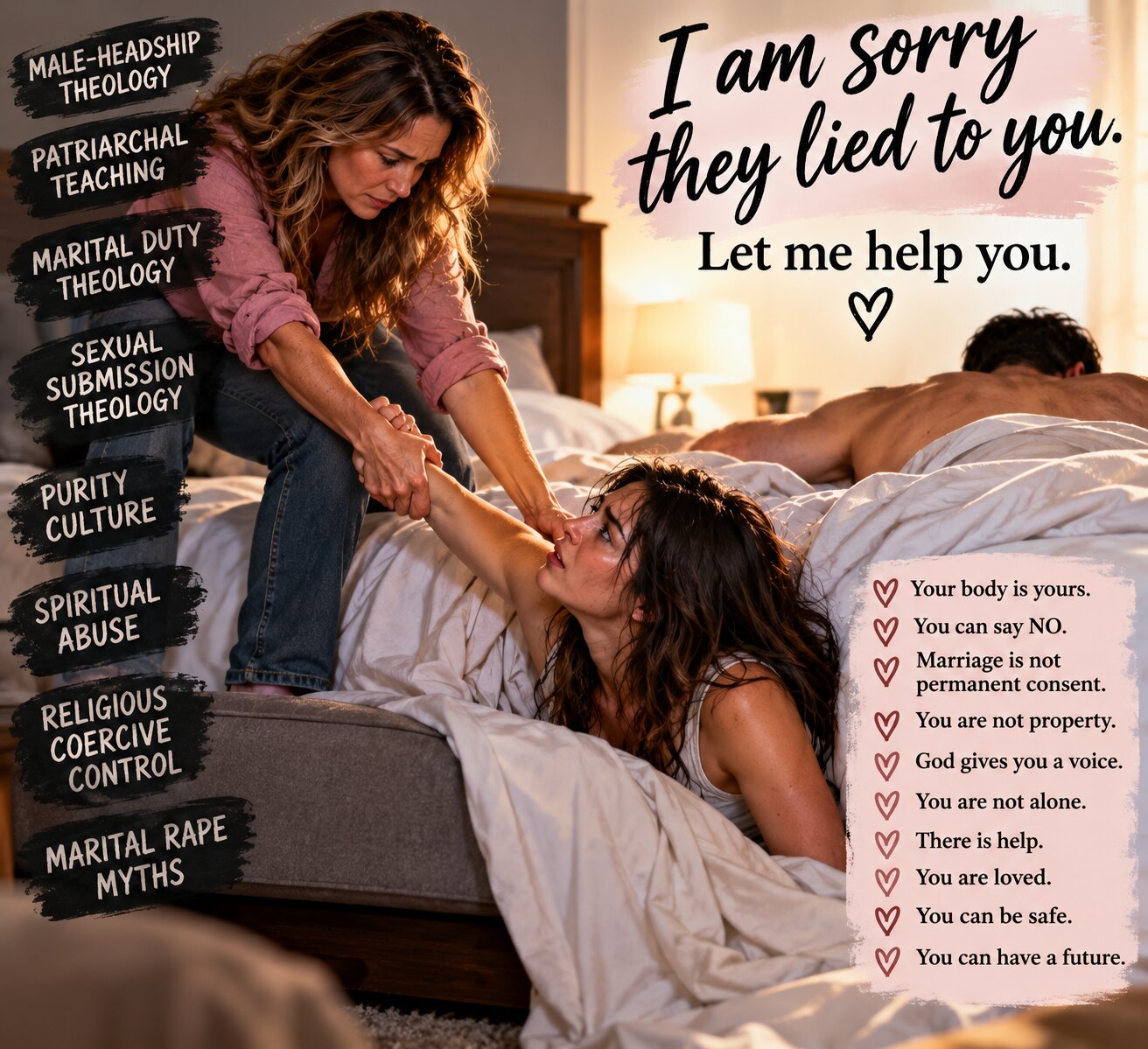
Marriage does not erase consent.
- A woman can say NO.
- A wife can say STOP.
- A person can change their mind.
- Consent to one activity is not consent to every activity.
- Past consent does not guarantee present consent.
- “I do” is not permanent consent to every future sexual act.
Term 07Category: Coercive behavior
Religious Coercive Control
Religious coercive control occurs when religious beliefs, spiritual authority, Scripture, or fear of divine consequences are used as mechanisms of control.
Examples
- “God commands you to submit.”
- “You’re disobeying God.”
- “A godly wife satisfies her husband.”
- “You’re causing him to sin.”
- “God hates divorce.”
- “You need to forgive him.”
- “Don’t expose your husband.”
- “You need to take this to God instead of telling people.”
- “You’re supposed to suffer like Christ.”
For someone whose faith is central to her identity, fear of disappointing God can become extraordinarily powerful leverage.
Using someone’s faith to override sexual boundaries, safety, agency, or consent is a misuse of spiritual authority.
Term 08Category: Abuse
Spiritual Abuse
Spiritual abuse is the use of religious beliefs, Scripture, church authority, spiritual status, or religious community to control, frighten, manipulate, shame, exploit, silence, or rationalize harm toward another person.
It can occur
- within intimate relationships
- within families
- within churches
- within pastoral relationships
- within counseling or ministry environments
A Bible verse does not transform coercion into holiness.
Term 09Category: Myths
Marital Rape Myths
These are common myths. Each one is false as a description of consent.
- Myth: “A husband can’t rape his wife.”
- Myth: “She already consented when she married him.”
- Myth: “Sex is his right because they’re married.”
- Myth: “A Christian wife shouldn’t refuse her husband.”
- Myth: “If she eventually stopped resisting, it wasn’t assault.”
- Myth: “If there wasn’t physical violence, she consented.”
- Myth: “If they’re still married, it couldn’t have been abuse.”
Marriage does not transform another person’s body into property.
A wedding ring is not permanent sexual consent.
Legal note: Definitions of sexual assault, rape, consent, and applicable criminal or civil law depend on jurisdiction. This resource provides education and is not legal advice.